

How to Store and Handle Lyophilized Research Peptides
A practical laboratory guide to storing and handling lyophilized research peptides: temperature, moisture, light, oxidation-prone residues, freeze-thaw cycles, aliquoting, and record keeping that protect sample integrity in in-vitro research.
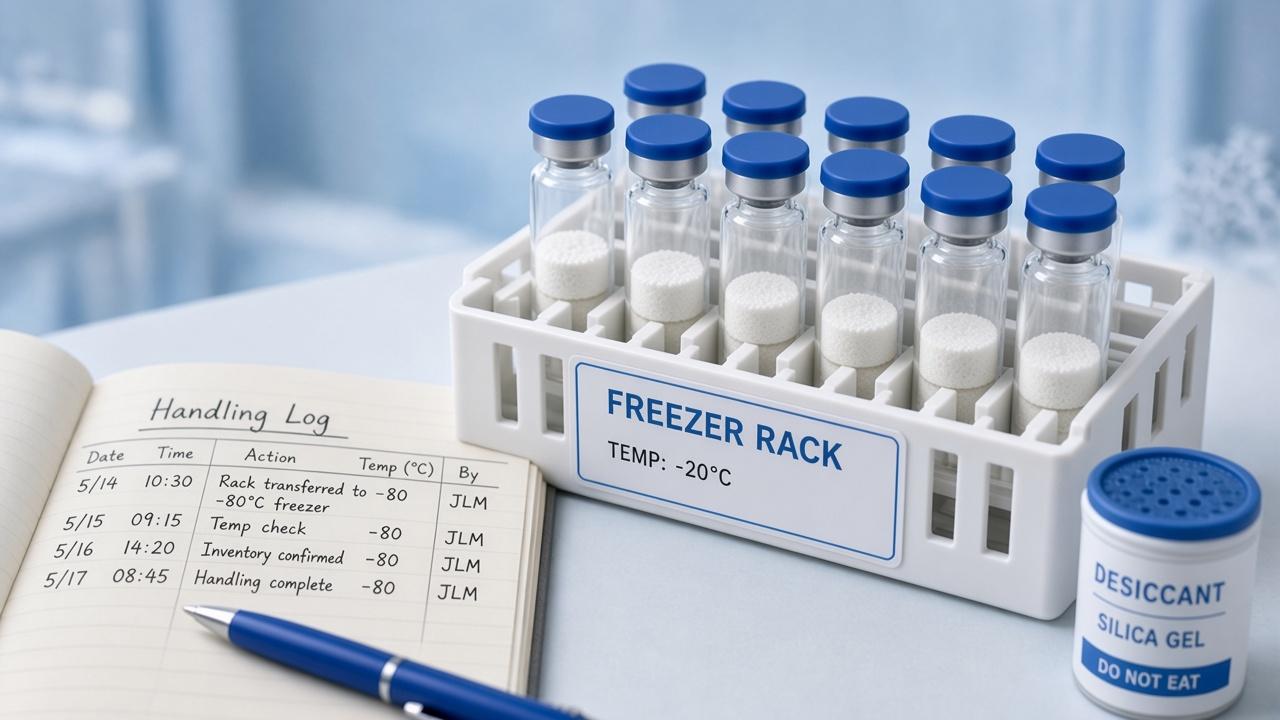
A peptide that leaves the synthesis lab at verified purity does not stay that way on its own. Between the Certificate of Analysis and the assay plate, temperature, humidity, light, oxygen, and repeated handling can all degrade a sample. For laboratories, careful storage and handling are as important to reproducible results as sourcing a well-characterized material in the first place.
This guide summarizes widely accepted practices for storing and handling lyophilized (freeze-dried) research peptides in a laboratory setting, why each practice matters chemically, and how to document handling so results stay traceable.
For Research Use Only – Not for Human Consumption. All products supplied by PrimeNexa Labz are intended strictly for laboratory and in-vitro research. They are not for human or animal use and are not intended to diagnose, treat, cure, or prevent any disease.
Why Peptides Degrade
Peptides are chemically defined but not chemically inert. Their stability depends heavily on sequence, and several well-characterized degradation pathways can alter a sample over time.
- Oxidation – Residues such as methionine, cysteine, and tryptophan are susceptible to oxidation by atmospheric oxygen, producing species with different masses and properties.
- Deamidation – Asparagine and glutamine side chains can deamidate, particularly in solution and at elevated pH or temperature.
- Hydrolysis – Peptide bonds, especially those adjacent to aspartic acid, can cleave over time in the presence of water.
- Aggregation – Some sequences self-associate, reducing the fraction of monomeric peptide available to an experiment.
- Moisture uptake – Lyophilized powders are often hygroscopic. Absorbed water accelerates the chemical pathways above and makes weighing less accurate.
Lyophilization removes most water and slows these processes considerably, which is why research peptides are typically supplied as dry powders. Slower is not the same as stopped, so storage conditions still matter.
Storing Lyophilized Peptides
Temperature
For long-term storage, lyophilized peptides are generally kept frozen, commonly at −20 °C, and away from bright light. GenScript's published guidelines note that most lyophilized peptides are stable for several years under these conditions, while emphasizing that stability is sequence-dependent. Short-term storage at refrigerated temperatures is common for material that will be used soon, but laboratories should follow the storage recommendation on the product label or COA for each lot.
Moisture
Moisture is one of the most common causes of avoidable degradation. Sequences rich in aspartic acid, glutamic acid, lysine, arginine, or histidine are especially prone to absorbing water from the air, and storage in a tightly capped vial inside a desiccator is recommended for these peptides.
A simple but frequently overlooked step: **allow a cold vial to reach room temperature before opening it.** Opening a cold vial in ambient air causes condensation to form on the powder, introducing exactly the moisture that lyophilization removed.
Oxygen and Light
Peptides containing cysteine, methionine, or tryptophan benefit from minimal air exposure. Practical measures include keeping vials sealed until use, limiting how long a vial stays open, and, where a laboratory has the capability, purging headspace with an inert gas such as nitrogen or argon before resealing. Amber vials or storage in a closed box limit light exposure.
Peptides in Solution
Once a peptide is dissolved for an experiment, its shelf life shortens dramatically. Solution-phase peptides are more exposed to hydrolysis, deamidation, oxidation, and microbial growth. GenScript advises against storing peptides in solution where possible. When it cannot be avoided, it recommends buffers at pH 5–6, dividing the solution into aliquots, storing aliquots at −20 °C, and avoiding freeze-thaw cycles. Filtering through a 0.2 µm filter can reduce the risk of bacterial contamination.
Solvent selection for in-vitro work depends on the sequence's charge and hydrophobicity and on what the downstream assay tolerates. Laboratories typically test solubility on a small portion of material first rather than committing an entire vial.
Freeze-Thaw Cycles and Aliquoting
Every freeze-thaw cycle is an opportunity for degradation and aggregation, and every opening is an opportunity for moisture and oxygen exposure. The most effective countermeasure is planning:
1. Estimate how much material each experimental set will require.
2. Divide the material into single-use aliquots at the outset.
3. Label each aliquot with the peptide name, lot number, concentration (if in solution), and preparation date.
4. Thaw only the aliquot needed, and discard unused portions rather than refreezing them.
Aliquoting reduces both freeze-thaw cycles and air exposure, and it keeps a single handling error from compromising the entire lot.
Documentation and Traceability
Good storage practice is only useful if it is recorded. A simple handling log supports reproducibility and makes troubleshooting far easier when results drift:
- Lot number and COA – Link every experiment to the specific lot used. PrimeNexa Labz provides a lot-specific COA for each product, verified by HPLC and mass spectrometry through independent laboratories (FAQ).
- Receipt date and storage location – Note when material arrived and where it is stored.
- Opening and aliquoting dates – Record when the primary vial was first opened and how it was divided.
- Solution preparation details – Solvent, concentration, pH, and date for any stock solution.
- Deviations – Note freezer failures, extended bench time, or any visible change in appearance.
If you are new to how identity and purity are verified, see our earlier article, [Understanding Research Peptides: What They Are and Why Quality Matters](/blog/understanding-research-peptides-what-they-are-and-why-quality-matters).
Quick Reference Checklist
- Store lyophilized peptides frozen (commonly −20 °C), dry, and protected from light, or as directed on the lot's label or COA.
- Let vials equilibrate to room temperature before opening.
- Keep vials tightly sealed; use a desiccator for hygroscopic sequences.
- Minimize air exposure for Cys-, Met-, and Trp-containing peptides.
- Avoid long-term storage in solution; if necessary, aliquot and freeze.
- Avoid repeated freeze-thaw cycles.
- Log lot numbers, dates, and handling steps for every experiment.
Frequently Asked Questions
How long do lyophilized research peptides remain stable?
Stability is sequence-dependent. Published supplier guidance indicates that many lyophilized peptides remain stable for years when stored frozen, dry, and away from light, but laboratories should follow the storage information on the specific lot's label or COA.
Why should a vial warm to room temperature before opening?
Opening a cold vial causes atmospheric moisture to condense on the powder. That water can accelerate hydrolysis, deamidation, and other degradation pathways.
Can peptide solutions be refrozen?
Repeated freeze-thaw cycles promote degradation and aggregation. The standard practice is to prepare single-use aliquots and discard any unused portion after thawing.
**Which amino acids make a peptide more sensitive to storage conditions?
Cysteine, methionine, and tryptophan are prone to oxidation; asparagine and glutamine can deamidate; and sequences rich in charged residues such as aspartic acid, glutamic acid, lysine, arginine, and histidine tend to absorb moisture.
Where can I find storage information for a specific product?
Refer to the product label and the lot-specific Certificate of Analysis, available from each product page in the PrimeNexa Labz catalog. For other questions, contact our team.
References
- Manning MC, Chou DK, Murphy BM, Payne RW, Katayama DS. Stability of Protein Pharmaceuticals: An Update. Pharmaceutical Research.
- GenScript. Peptide Storage and Handling Guidelines.
---
*Disclaimer: All products sold by PrimeNexa Labz are intended for Research Use Only (RUO) in in-vitro and laboratory settings. They are not for human or animal consumption, are not drugs, foods, dietary supplements, or cosmetics, and are not intended to diagnose, treat, cure, mitigate, or prevent any disease. This article is provided for educational purposes and does not constitute medical advice or guidance on dosing or administration. Statements on this site have not been evaluated by the Food and Drug Administration.*